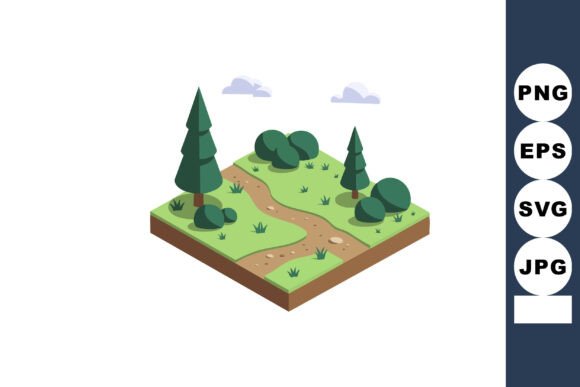
Isometric Forest Path with Pine Trees: A Unique Visual Asset for Designers and Creators
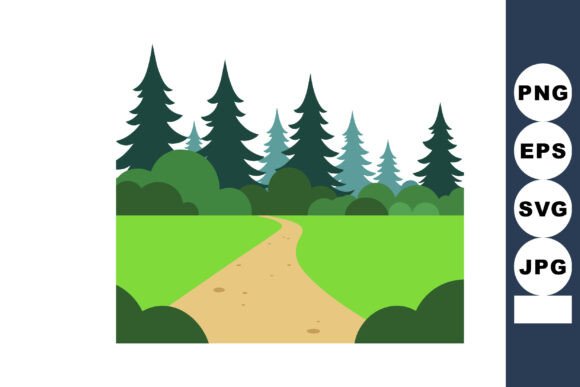
The Isometric Forest Path with Pine Trees is a distinct digital illustration that captures a serene, winding forest trail surrounded by tall pines and underbrush under a soft, cloudy sky. This isometric-style image offers a three-dimensional perspective without the distortion of traditional perspective drawing, making it a versatile choice for designers across multiple industries. Whether used in educational materials, game development, web design, or print media, this illustration provides a calming, immersive visual that can enhance a wide range of projects.
What Makes Isometric Forest Path with Pine Trees Unique?
Isometric illustrations like the Isometric Forest Path with Pine Trees are known for their ability to represent depth and spatial relationships without the complexity of full 3D modeling. This particular design stands out due to its attention to natural detail, balanced composition, and atmospheric mood. The cloudy sky, winding path, and evenly spaced pine trees contribute to a sense of quiet exploration and gentle movement.
Unlike traditional top-down or side-view illustrations, isometric visuals allow viewers to perceive multiple surfaces of objects at once. This makes the Isometric Forest Path with Pine Trees especially useful for applications where clarity and spatial understanding are important, such as instructional graphics, game maps, or architectural visualizations.
Comparing Isometric Forest Path with Pine Trees to Other Visual Styles
When compared to other visual assets like realistic photographs, vector icons, or full 3D renderings, the Isometric Forest Path with Pine Trees offers a middle ground between stylization and realism. It avoids the rigidity of flat design while also sidestepping the computational demands of 3D modeling. This balance makes it a practical option for creators who need a visually engaging yet lightweight asset.
- Photographic images offer realism but are often less flexible for editing and scaling without loss of quality.
- Flat design illustrations are simple and modern but may lack the depth needed for certain spatial or narrative applications.
- 3D models provide the most immersive experience but require more technical expertise and processing power.
The Isometric Forest Path with Pine Trees strikes a balance between these extremes, offering a clean, scalable, and visually engaging format that’s accessible to a wide range of users.
Strengths and Best Use Cases for Isometric Forest Path with Pine Trees
This illustration excels in situations where visual storytelling and spatial clarity are important. It works well in:
- Educational materials – Ideal for geography lessons, nature guides, or environmental science content.
- Game development – Perfect for 2D games that use isometric tiles to simulate depth without complex rendering.
- Web and app design – Can be used as a background, icon, or navigational element in nature-themed interfaces.
- Presentation slides – Adds a professional, calming visual to business or educational decks focused on sustainability, travel, or ecology.
The Isometric Forest Path with Pine Trees is particularly effective when the goal is to convey a sense of calm, exploration, or natural beauty without overwhelming the viewer with detail or realism.
Tradeoffs and Limitations to Consider
While the Isometric Forest Path with Pine Trees has many strengths, it may not be the best fit for every project. For instance:
- It may not offer the same level of realism as a high-resolution photograph, which could be a drawback for projects requiring precise environmental representation.
- Its isometric perspective is fixed, so users who need customizable camera angles may find it limiting compared to 3D models.
- In highly stylized or abstract design contexts, it may feel too grounded or literal.
These limitations don’t diminish the value of the Isometric Forest Path with Pine Trees, but they should be considered when selecting the right visual asset for a specific project.
When Is Isometric Forest Path with Pine Trees the Right Choice?
Choosing the Isometric Forest Path with Pine Trees makes sense when you need a visually appealing, scalable, and easy-to-integrate asset that conveys a natural, peaceful setting. It's especially well-suited for:
- Designers creating nature-themed apps or websites where a sense of space and environment matters.
- Game developers building 2D environments that benefit from a pseudo-3D effect without the overhead of full 3D engines.
- Educators or content creators who want to visually support lessons about forests, ecology, or outdoor navigation.
If your project requires a balance between visual richness and technical simplicity, the Isometric Forest Path with Pine Trees is likely a strong contender.
When You Might Consider Alternatives
There are scenarios where other visual assets might be more appropriate. If your project requires:
- High realism – For example, in a documentary or photo-based portfolio – a detailed photograph might be more suitable.
- Dynamic camera movement – such as in a 3D game or virtual tour – then a full 3D model or animation could be necessary.
- Minimalist aesthetics – you might prefer flat design icons or abstract illustrations that align more closely with modern design trends.
In these cases, the Isometric Forest Path with Pine Trees may not fully meet your needs, and exploring alternative formats could lead to better results.
Practical Example: Choosing Between Isometric and Photographic Assets
Imagine you're designing a mobile app that teaches users how to navigate forest trails. Using the Isometric Forest Path with Pine Trees would allow you to show the layout of the trail clearly while maintaining a clean, stylized appearance. In contrast, using a real-world photo might provide more visual accuracy but could be harder to adapt for different screen sizes or color themes. The isometric illustration offers a more flexible and scalable solution for this kind of educational tool.
Conclusion
The Isometric Forest Path with Pine Trees is a versatile and thoughtfully designed illustration that brings a sense of calm and exploration to a variety of creative projects. Its isometric format bridges the gap between flat design and full 3D, offering both visual appeal and practical usability. While it may not be the best fit for every situation, it provides a strong combination of clarity, style, and adaptability that makes it a valuable asset for designers, educators, and developers alike. When evaluating visual resources, consider how this illustration aligns with your project's goals, technical requirements, and aesthetic direction to determine if it’s the right choice for you.